

Page speed is one of the clearest signals that connects marketing and engineering. When a page loads slowly, people leave. When people leave, Google sees a weaker experience - and paid traffic becomes more expensive because fewer clicks turn into enquiries.
That is why we treat performance as part of SEO and paid acquisition, not as a polish step at the end of a project.
What Google actually measures
Google looks at real user experience through a set of metrics called Core Web Vitals. Three matter most for a typical business site:
- LCP (Largest Contentful Paint): how quickly the largest visible element - usually a hero image or headline - finishes rendering. Google's threshold for “good” is under 2.5 seconds.
- INP (Interaction to Next Paint): how responsive the page feels across the whole visit, measuring the delay between a tap or click and the next visual update. Under 200 milliseconds is considered good.
- CLS (Cumulative Layout Shift): how much visible content jumps around while the page loads, usually because images or ads load without reserved space. A score under 0.1 is considered good.
These are field metrics, collected from real Chrome users through the Chrome User Experience Report - not a single lab test run on a fast office connection. A site can look fine in a quiet office on fast Wi-Fi and still fail on a mid-range Android phone on patchy mobile data, which is exactly the environment a large share of real visitors use.
How speed affects organic SEO
Speed is not the only ranking factor, and it will not rescue thin or irrelevant content. But when two pages compete on similar topics and similar authority, a better experience is often what tips the balance and helps you stay in the fight for a position.
Slow pages also create secondary SEO damage that compounds over time: higher bounce rates, fewer pages viewed per session, weaker average engagement, and less willingness from Googlebot to crawl deep or frequently when a site consistently feels heavy to fetch. None of that shows up as a single obvious penalty - it shows up as a slow erosion of visibility that is hard to trace back to one cause.
It is also worth remembering that Google crawls and indexes primarily using its mobile crawler. A page that only feels fast on a desktop in the office is being judged on an experience most real visitors never actually get to try.
Why paid campaigns feel the pain first
In Google Ads, the story is even more direct, because you are paying for every single click regardless of what happens next. If the landing page takes four seconds to become usable, you are paying full price for visitors who never see the offer you built the campaign around.
Over time that drags down conversion rate, and conversion rate is one of the inputs behind Quality Score alongside expected click-through rate and ad relevance. A worse Quality Score usually means a higher cost per click for the exact same auction position - so a slow site quietly taxes every campaign running on top of it, whether anyone on the marketing team notices or not.

What usually makes sites slow
Most business sites do not need exotic optimisation or a full rebuild. The common offenders are predictable and, in most cases, fixable within days rather than months:
- Uncompressed or oversized photos, especially full-width hero images exported straight from a camera or stock library.
- Heavy page builders and drag-and-drop plugins that ship far more CSS and JavaScript than the page actually uses.
- Render-blocking fonts and third-party scripts - chat widgets, tag managers, embedded videos, review widgets - loaded before anything the visitor actually asked to see.
- Hosting or frameworks that send a large amount of HTML and server processing time before any useful content appears.
- Fonts loaded from multiple providers or in multiple weights that are never actually used on the page.
How to prioritise fixes when you cannot do everything at once
Not every slow site needs every fix at once, and trying to do all of it in one sprint usually stalls a project. A useful order is to fix whatever affects the most visited pages first - typically the homepage and the top landing pages carrying ads or organic traffic - rather than spreading effort evenly across the whole site.
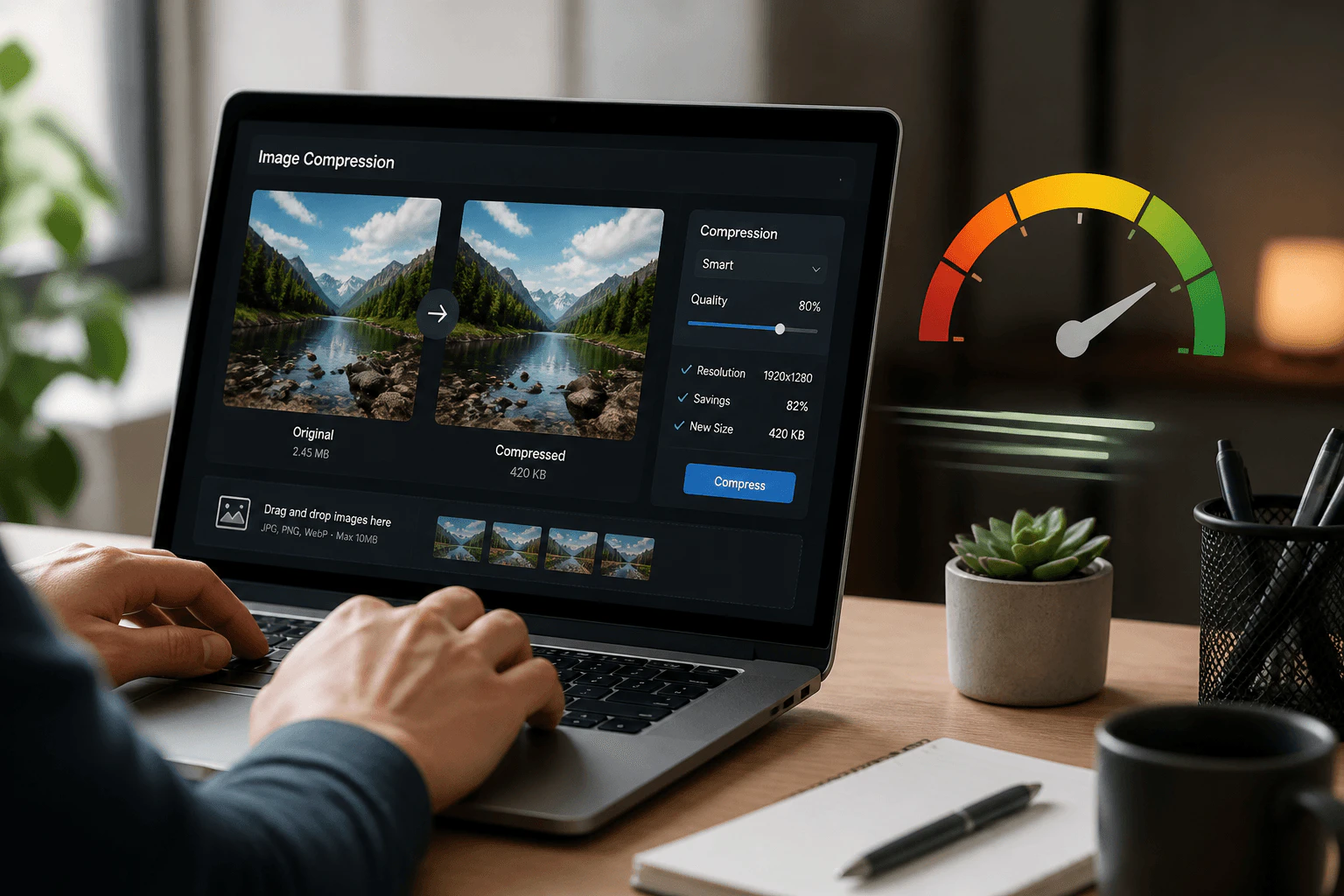
Image weight is almost always the fastest win, since compressing and resizing hero images rarely breaks anything else. Script cleanup comes next, because removing or delaying unused third-party tags is usually safe and reversible. Framework or hosting changes belong last, since they touch more of the site and carry more risk - worth doing, but only once the cheaper wins are already banked and measured.
A useful gut check: if PageSpeed Insights flags a two-megabyte hero image displayed at 800 pixels wide, resizing and compressing it before touching anything else on the report is rarely the wrong call. It is one of the few fixes reliable enough to move the field score within a single Search Console reporting cycle, which makes it a good first data point to show a client that the work is actually paying off.
A practical checklist
- Measure with PageSpeed Insights and Search Console's Core Web Vitals report - not only one desktop lab score that never sees real traffic conditions.
- Compress images, serve modern formats like WebP or AVIF, and set explicit width and height so the browser reserves space and avoids layout shift.
- Remove or delay scripts you do not need on the landing page; marketing tags can often wait until after first paint without losing meaningful data.
- Prefer a lean stack - for example Next.js with static or cached pages - over a bloated CMS theme for pages that carry campaign traffic.
- Re-test on a mid-range Android phone on a throttled mobile network before scaling ad spend, not only on a desktop in the office.
- Revisit Core Web Vitals after any redesign, new plugin, or added tracking script - regressions creep in quietly.
Build fast, then scale traffic
A fast site is not only a technical win. It lowers friction from first click to enquiry, supports better rankings over time as engagement signals improve, and makes every marketing euro work harder because fewer clicks are wasted on visitors who never saw the offer.
At Killer Click we build for speed first, then grow traffic with SEO and paid campaigns that land on pages already ready to convert. If your site already ranks or already spends on ads, fixing performance is often the single highest-return change you can make this quarter.